
Remembering the Trains in Francis
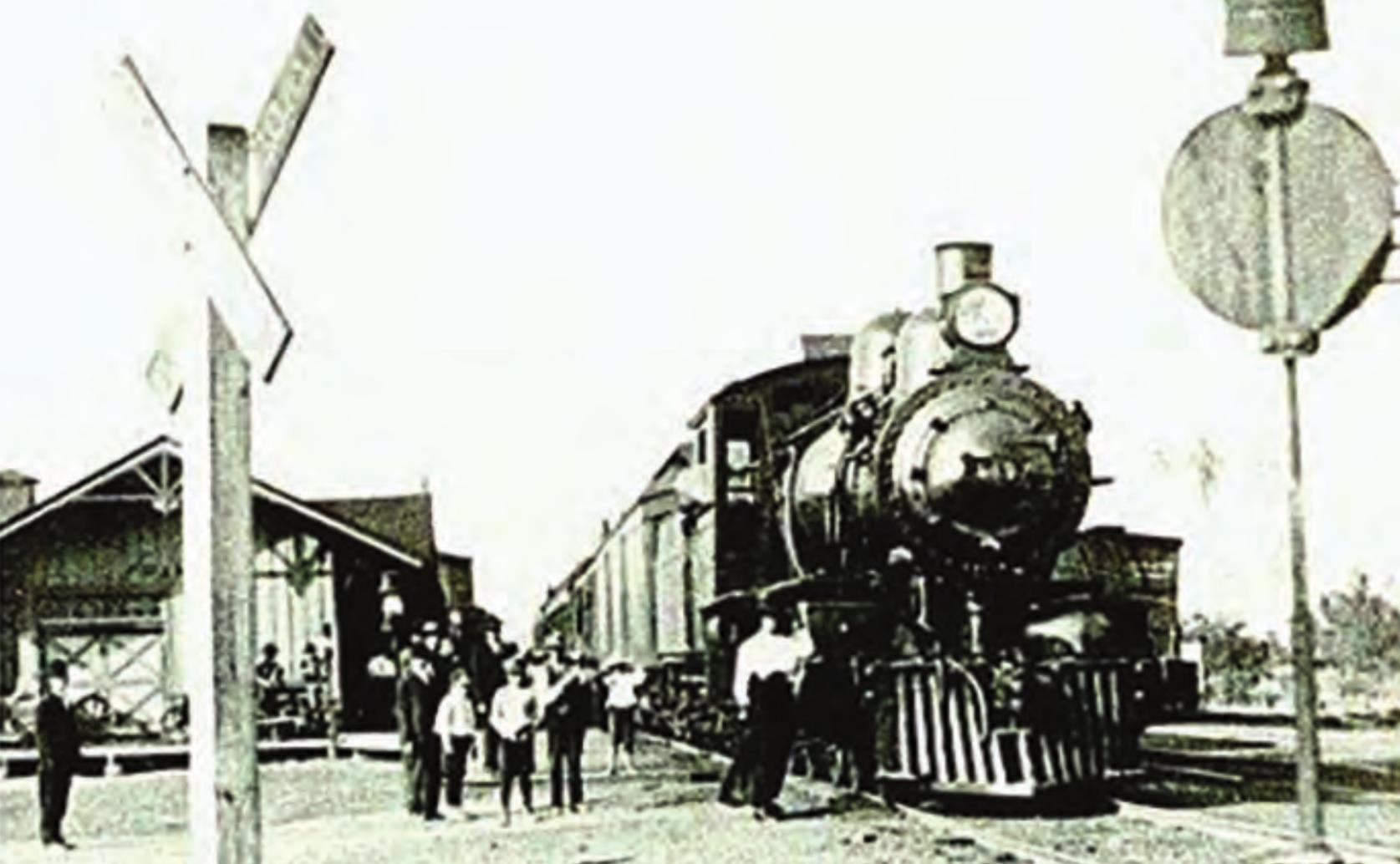
Named for a former Missouri governor and secretary of the interior, David R. Francis, the town of Francis was incorporated in spring 1901.
Construction of the St. Louis, Oklahoma and Southern Railway across the Chickasaw Nation, Indian Territory, began in 1900. Approximately two miles south of the Canadian River the track bypassed the settlement of Newton, prompting residents to relocate. The Newton post office was moved to the site of a train depot, named Francis by railroad officials. Newton’s postal designation was changed to Francis in 1902.
Within two months of its founding Francis had a population of approximately five hundred. The weekly Francis Banner began publication in January 1901. Later newspapers included the Francis Wigwam, the Franciscan, and the Francis Bulletin. A hotel, a hardware store, a lumberyard, a feedlot, and several general merchandise stores were in business by July 1901. In addition, several fraternal orders were active, a public school had opened, and a cotton gin was under construction.
The St. Louis and San Francisco Railway (or Frisco) purchased the St. Louis, Oklahoma and Southern Railway in 1901. Positioned halfway between Sherman, Texas, and Sapulpa in the Creek Nation, Francis became a division point on the line. Regional and divisional Frisco offices were established there between 1904 and 1906. Rail sidings, a roundhouse, a turntable, repair shops, and a Harvey House restaurant were situated near the depot. The railroad was Francis’ largest employer until about 1916 when the Frisco facilities began closing.
After rail construction had reached Sherman, Texas and regular service was in operation, the town of Francis was named a terminal of the Red River Division of the Frisco. The location of the town made it a natural for this selection as it was almost exactly half way between Sherman and Sapulpa. Between Francis and Sapulpa, about 100 miles, the line was known as the Creek Sub-Division. To the south from Francis to Sherman, again about 100 miles, was the Sherman Sub-Division. A day’s run for trainmen, then and now, is 100 miles, so it is easy to see why Francis would develop into a railroad town. Here was where the crews changed on a train. If a person lived at Francis they could get a trip going north or if these were all filled then perhaps a run south to Sherman.
Very rapidly, the Frisco Railroad developed facilities at Francis which made it a very prosperous community. By 1907, the population was over the one thousand mark and the railroad payroll was $25,000 per year. At this time a worker’s daily pay was about one dollar while a railroad man earned about two dollars and fifty cents in the same amount of time. Because of railroad expansion, new homes were being built, three banks, boarding houses, cafes and stores were going up, as more and more people came to this new town with a stable economy.
To get an overview of how extensive railroad operations were in Francis during this time, just a review of facilities is now in order. The Frisco first built a wye so that entire trains could be turned around and this was on the east side of the main line and was rather inconvenient for train crews. When the five stall brick roundhouse and turntable were built the wye was removed. A large coaling tower was located just north of the roundhouse until oil came into use as fuel in 1939.
Other structures included double water tanks, car repair house, sand house, scale house, office of the Sub-Division Superintendent, offices of two Roadmasters (track maintenance) one crew for the main line and another for the yard. The yard at Francis consists of six car classification tracks, plus storage tracks, a rip track (car repair) and the main line. Three switch engines were always based at Francis. Each day, one of these 1200 Class, Consolidation engines would perform the switching chores in Ada and Francis. Another engine would work the yards in Mill Creek and Sulphur. The third engine would haul material from the pit at Lawrence to the Ada Ideal Cement Plant. Because of all this traffic there was much clingclanging around the yards in all of these towns every day.
How many railroad men worked in Francis during this time? No accurate figure seems to exist but estimates indicate approximately five hundred men including transit train crews. This seems to be reasonable when one thinks back over the list of structures and the many jobs that were performed at Francis and we have not even mentioned the hub of activity, the depot, which utilized two sets of operators per shift, due to the traffic and this alone accounted for eighteen men per day. The total railroad facility at Francis on the other hand, was not a large one by Frisco standards, but, without a doubt, it had all the necessary components.
Railroad operations through Pontotoc County during the early years was very heavy, being 20-30 trains a day. The Frisco ran six passenger trains a day and even carried people on the local freights.
Since George M. Pullman made it possible for railroad passengers to sleep in comfort, Frederick H. Harvey let them eat without fear of food poisoning. In the western part of the U. S. food in depot lunch counters was always bad and service poor. Fred Harvey, a Kansas restaurant man, persuaded the Santa Fe Railroad in 1876 that it would be good for business to see that the passengers received better treatment.
By 1900, when the Frisco reached this county, Harvey had fifteen hotels, forty-seven restaurants and a fleet of thirty dining cars. As soon as Francis was named a Frisco terminal, a Harvey House was built and in 1904 was enlarged. This large one-story brick structure was located just north of the depot and west of the tracks. Directly behind the Harvey House was the large two-story dormitory for the famous. “Harvey Girls.”
Fred Harvey is probably best remembered for two things, one was good food, the other, for his “Harvey Girls.” He wanted his waitresses to be pretty and ladylike The “Harvey Girls” all wore black dresses with bows, black shoes and stockings, and white hair ribbons. They earned $17.50 a month plus room and board, and had to keep a strict 10:00 P.M. curfew. There were always many more men than women along the Frisco line, so the pretty “Harvey Girls” always had plenty of beaus, and this kept Fred Harvey busy finding replacements for those who married. They seemed to prefer railroad men, and some 5,000 of them, according to Santa Fe historians, married engineers, conductors and station agents.
The Francis Harvey House was managed by H. R. Hockstrasser and the fine food served there was said to be better than that of the original Harvey House in Kansas City. Each day two passenger trains, one going north, the other south, stopped at Francis so that the passengers could have lunch. During the time the passengers were eating, crews changed on the trains and the engines were serviced with coal and water. In the evening this same procedure was followed for the dinner meal. Besides this traffic each day, nearly all the local railroad men and many Francis residents and some from Ada went to the Harvey House for food.
In 1925, as a part of railroad re-organization, the Frisco removed Francis as a terminal point. This one event was to have a great effect upon the lives of many people and ultimately the town itself. The first change to be seen was in the closing of the Harvey House.
In an attempt to speed up passenger schedules the Frisco put on dining cars and Pullman sleepers. Trains No. 9 and No 10 were specially groomed and polished and were well known by the public as the fastest and most luxurious passenger trains in this part of the country. Because of the railroad reorganization the Francis roundhouse was closed in 1926 and major engine repairs were shifted to Sherman or Sapulpa. Thereafter, the old overhead belt-powered machine shops had only minor or infrequent use and these facilities were closed in 1930.
Until the end of World War I, no form of transportation came close to challenging the railroad but after that date more and more people began to travel by car, bus and plane. In the 1950’s, many railroads cut down on passenger service. For many years, until 1959, the Frisco operated a direct Ada-Tulsa daily train. This train would arrive in Ada one day, spend the night and return to Tulsa the next day. Always popular with residents along the way, this was perhaps one of the last “milk trains” in this part of the country. These trains would stop and pick up a person anywhere along the way, or for that matter, simply a can of milk or a case of chickens. In most cases the Tulsa train was pulled by a small steam “teakettle” engine number 185, and this was followed by a baggage car, mail car and two passenger cars.
The Frisco continued its passenger trains longer than many, but the trend was clear and the last passenger train came through Pontotoc County on a regular schedule in February 1960. A public transportation era had ended.
The first Frisco diesel arrived in Francis in 1951 pulling a troop train to Texas during the Korean War.
The first Frisco depot built at Francis was in 1901 and this served the public until it was destroyed by fire in 1921. This building was replaced and the new depot was in operation until April 16, 1973 when Francis was closed as a Division Point. The depot was torn down during the months of October-December, 1973, as was the train crew building.
From every indication, as a railroad town Francis reached its peak in the years from 1907 to 1926. Francis declined after World War I. Its population fell steadily from 931 in 1910 to 271 in 1950. By the 1970s few businesses remained. In 2000 Francis had 332 residents and in 2010, 315.
Our thanks to Sandra Roberts of The Diamond Shop, Ada, for sharing information from the Pontotoc County Historical Society.