
Miracle on 95th Street: Little Virginia’s Letter

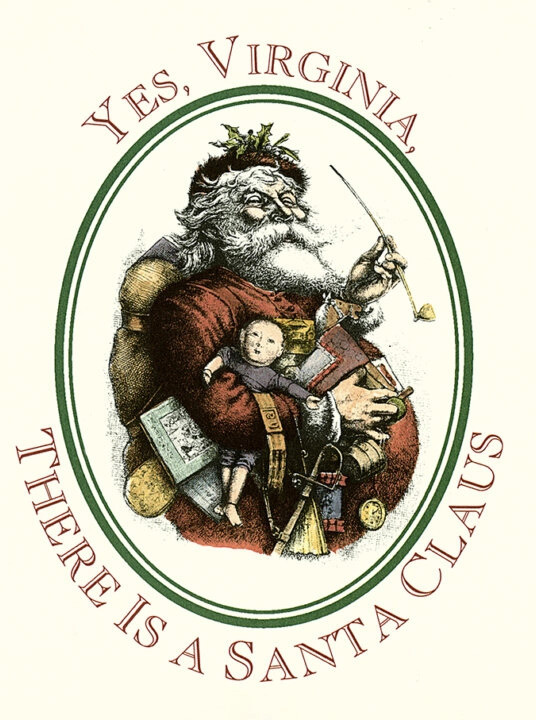
An answer to the 8-year-old Virginia O’Hanlon’s written inquiry, “Yes, Virginia, there is a Santa Claus” has been printed in newspapers throughout the nation.
One of the most beloved Christmas stories traces its origins to a picturesque street on Manhattan’s Upper West Side neighborhood. The brownstone and brick rowhouse at 115 W. 95th St. was the childhood home of Virginia O’Hanlon, the eponymous girl in the “Yes, Virginia, there is a Santa Claus” 1897 editorial published by The Sun.
This editorial has become legendary; it’s the most republished editorial in American journalism. The text has entered the Christmas canon with families and communities rereading it as part of their annual celebratory tradition.
The now-iconic image of Santa Claus was fashioned only 3 1/2 decades before the famous editorial. It was created by German-born American artist Thomas Nast, called the “Father of the American Cartoon,” during the Civil War. Nast’s vision showed Santa Claus as a rotund, jolly gift-giver. His first depiction was published as the cover image of Harper’s Weekly in 1863. Nast’s Santa Claus derived from European versions of Saint Nicholas merged with German elvish folk images. Subsequent color portrayals by Nast showed a Santa with a white beard wearing a red suit.
The editorial printed by The Sun was prompted by the query of an 8-year-old Virginia O‘Hanlon (1889–1971). Due to the influence of some friends, she’d begun to doubt the existence of Santa Claus. Her father, a prominent physician, advised her to write to the local newspaper, The Sun, and pose the question to them. He assured her that they were a trustworthy source that would be able to answer it. In her endearing, youthful scrawl, she submitted a four-sentence letter to the paper’s editor in July 1897: “Dear Editor, I am eight years old. Some of my little friends say there is no Santa Claus. Papa says “if you see it in the Sun, it’s so.” Please tell me the truth, is there a Santa Claus? Virginia O’Hanlon” It appears that the newspaper initially misplaced Virginia’s letter. Eventually, it found its way to the editorial page editor, who handed it to his lead editorial writer, Francis Pharcellus Church, for reply. Church (1839–1906) composed an affirmative response of under 500 words. It was printed anonymously on Sept. 21, 1897, without any special presentation, and it met with little fanfare. Virginia, who had been on the lookout for months, was delighted to have proof of Santa’s existence at last.
‘Yes, Virginia, There Is a Santa Claus’
The reply caught the attention of a few eagle-eyed readers, and several asked the paper to reprint it, an unusual request. It took five years for The Sun to do so; the paper did not make it an annual custom until the 1920s. Since then, the editorial’s popularity has soared. “Yes, Virginia, there is a Santa Claus” has been printed in newspapers throughout the nation, translated into more than 20 languages, set to music, and even adapted for film and television. Its enduring message has resonated due to the brilliance of Church’s language, style, and tone. Some liken the text to a free verse poem. Church answered Virginia’s question without a hint of condescension. He imparted a philosophical approach to life: “Yes, Virginia, there is a Santa Claus. He exists as certainly as love and generosity and devotion exist, and you know that they abound and give to our life its highest beauty and joy. Alas! How dreary would be the world if there were no Santa Claus! It would be as dreary as if there were no Virginias. There would be no childlike faith then, no poetry, no romance to make tolerable this existence. We should have no enjoyment, except in sense and sight. The eternal light with which childhood fills the world would be extinguished.”
The writer went on to state that “there is a veil covering the unseen world which not the strongest man, or even the united strength of all the strongest men that ever lived, could tear apart. Only faith, fancy, poetry, love, romance, can push aside that curtain and view and picture the supernatural beauty and glory beyond.”
Church was an unlikely candidate to answer a little girl’s query about Santa Claus. The son of a notable clergyman, he was a Civil War correspondent before becoming a seasoned editorialist at The Sun. Described as “energetic and a brilliant conversationalist,” he was also called “sardonic