
Masking our Fears
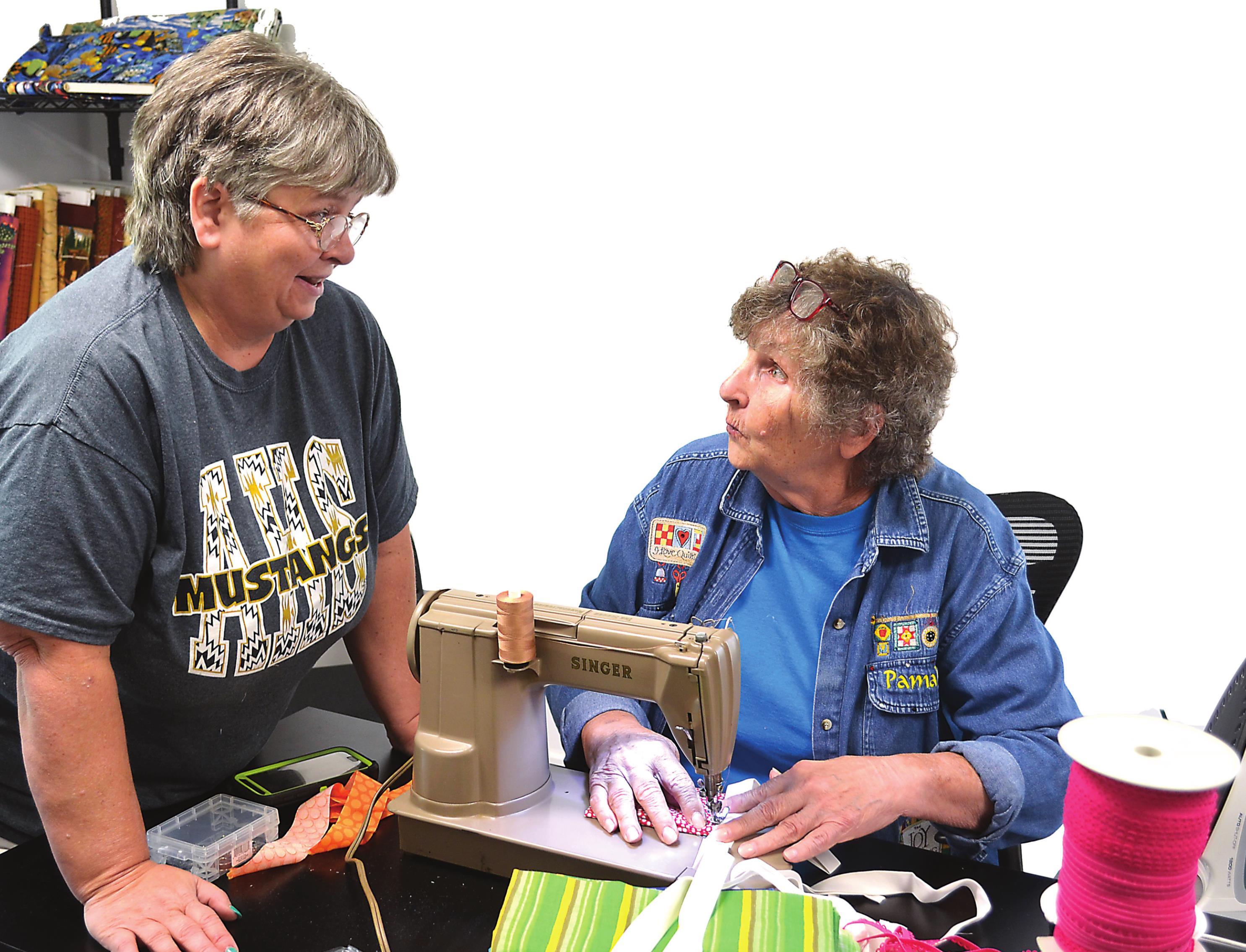
Making protective nonsurgical masks is a great way to help during this critical time and Allen is doing their part to assist in this time of need. Prairie Notions has received a total of 4800 yards of quarter-inch elastic, enough to make 16,000 masks, donated by Komar Industries of McAlester and has distributed it to local seamstresses as well as sharing it with others as far away as New Hampshire. The local business has also given out supplies to make six to eight thousand masks and collected approximately 500 locally-made masks for area medical facilities.
And Allen isn’t alone. As the “shelter in place” continues, individuals who have the ability to sew are making masks by the hundreds including a group of inmates at one Oklahoma correctional center.
The Warriors Quilting Club at Mabel Bassett Correctional Center in McLoud is a team of inmates who share a love of sewing. The group is using their talents to sew masks for health care workers from fabric donated by Hobby Lobby for the project.
“It means a lot to me to be able to give back to the community, and to make a difference, and to show that we are more than just a number,” said Kelsey, an inmate at MBCC. “And that we actually do care about the community and giving back.”
“These ladies are great at what they do. They’re great at sewing. They’re great at putting stuff together,” said Cpt. Clint Bennett. “They work well as a team, and we have all this here and we decided we needed to step up and help.”
The time has come to stop debating the mask — and just wear them, at least inside hospitals. Even some top health systems have complicated policies about who among their employees should wear face masks and when, which is sowing confusion amid the coronavirus pandemic.
Last week, Partners HealthCare, which runs some of the top hospitals in Boston including Massachusetts General Hospital, said masks must be worn “continuously” through shifts at any of its clinical care facilities. Academic hospitals in Chicago and New York have now said the same. Yet many hospitals, particularly those where the virus crisis has not yet hit so hard, have continued to let many of their health-care workers go unmasked.
Doctors across the country are raising concerns about this. While the health system is testing and sequestering people suspected of having Covid-19, the bigger risk to health-care workers (and patients) may be those who are unknowingly infected yet still able to spread the virus and infect those around these.
Without adequate, accurate and fast testing, staff cannot know who is or is not infectious. Yet they are not treating everyone, health-care workers and patients, as potentially infectious — or susceptible to infection by those who are infected without showing any sign of the disease.
This concern is what motivates the recommendations to selfquarantine for 14 days if you travel from a highrisk area, such as New York City: You may be carrying the virus; you may be on the cusp of developing symptoms — or you may never develop symptoms — but you should protect others until the two-week selfquarantine has passed.
What that means for all of us — in hospitals and out — is that any other person we come in contact with may have the virus.
A universal precautions mentality needs to be adopted immediately. Universal precautions is an approach to infection control that assumes all body fluids could be infected and must be treated as such. Early in the AIDS epidemic, HIV, the virus that causes AIDS, infected health workers through needle sticks and other exposures to blood products. Experts introduced universal precautions as HIV spread and health-care workers were recognized as being at risk from handling fluids from patients.
Those who treated HIV-positive patients in the early days developed practices that for handling of all fluids capable of transmitting infection because was apparent that some patients might be carrying the virus without us knowing it.
Today it is the novel coronavirus that causes covid-19. It cannot be known for certain who has covid-19 and can infect others.
The only reasonable approach to keeping health-care workers safe is to assume that anyone can spread the virus. Moreover, that is the only way to ensure the safety of patients who are not infected from health-care workers who might be asymptomatic.
Although there remain a lot of unknowns with this new coronavirus, we know with reasonable confidence that personal protective equipment, commonly known as PPE, can decrease risk. Properly used, PPE, along with good hand-washing and wiping of surfaces can keep health-care workers safe. The PPE needs to be high quality and worn appropriately. The hand-washing needs to be intensive and the housekeeping fastidious. But it can be done.
Many people think of PPE as the mask, face shield, gloves and gowns — and it is just impracticable to wear them all on every interaction. But wearing at least a surgical mask or higher-filtering N95 mask, along with hand hygiene, would be universal protection in high-risk environments where people are gathering. If there is contact with a possibly infected patient in the course of clinical care, then the entire PPE is needed.
The infection of health-care workers (and patients by health-care workers) should be understood as a safety issue — that is, preventable with proper, high-quality practices. Commitment should be made to making it a “never event.” As a result, harm to a health-care worker, and by extension, to their families and friends as a result of their service on the front lines, should be a never event.
In many places in China, hospitals adopted these practices. Chinese experts reported that they were able to eliminate health-care worker infection in many settings where they used PPE and other best practices. Even when not in direct contact with patients. They wore masks throughout the hospital, not just in the covid-19 wards. When stocks were low, they wore their masks all day, doing their best to conserve them when they could.
So what should the USA do? We must destigmatize the use of masks and other gear. In many parts of Asia, people with colds typically use masks to protect others.
Let’s start changing the mind-set and using what we have. Research will ultimately tell us what masks are effective in what settings, but we need to act now on the best information we have.
And we should be thinking of this more broadly as extending to everyone providing vital services on the front lines, including police officers, firefighters, cashiers at pharmacies and grocery stores, and others in such positions. All of these individuals are placing themselves in the path of the virus to help others. Yet, they can infect and be infected. We need not only the PPE but also the mind-set. So, who needs a mask and how/when should it be worn.
If you are healthy, you only need to wear a mask if you are taking care of a person with suspected 2019-CoV infection.
Wear a mask if you are coughing or sneezing.
Masks are effective only when used in combination with frequent hand-cleaning with alcohol-based hand rub or soap and water.
And if you wear a mask, then you must know how to use it and dispose of it properly.
Before putting on a mask, clean hands with alcohol-based hand rub or soap and water.
Cover mouth and nose with mask and make sure there are no gaps between your face and the mask.
Avoid touching the mask while using it; if you do, clean your hands with alcohol-based hand rub or soap and water.
Replace the mask with a new one as soon as it is damp and do not re-use single-use masks.
To remove the mask: remove it from behind (do not touch the front of mask); discard immediately in a closed bin; clean hands with alcohol-based hand rub or soap and water.