
Maloy retires, Rinehart new School Board President

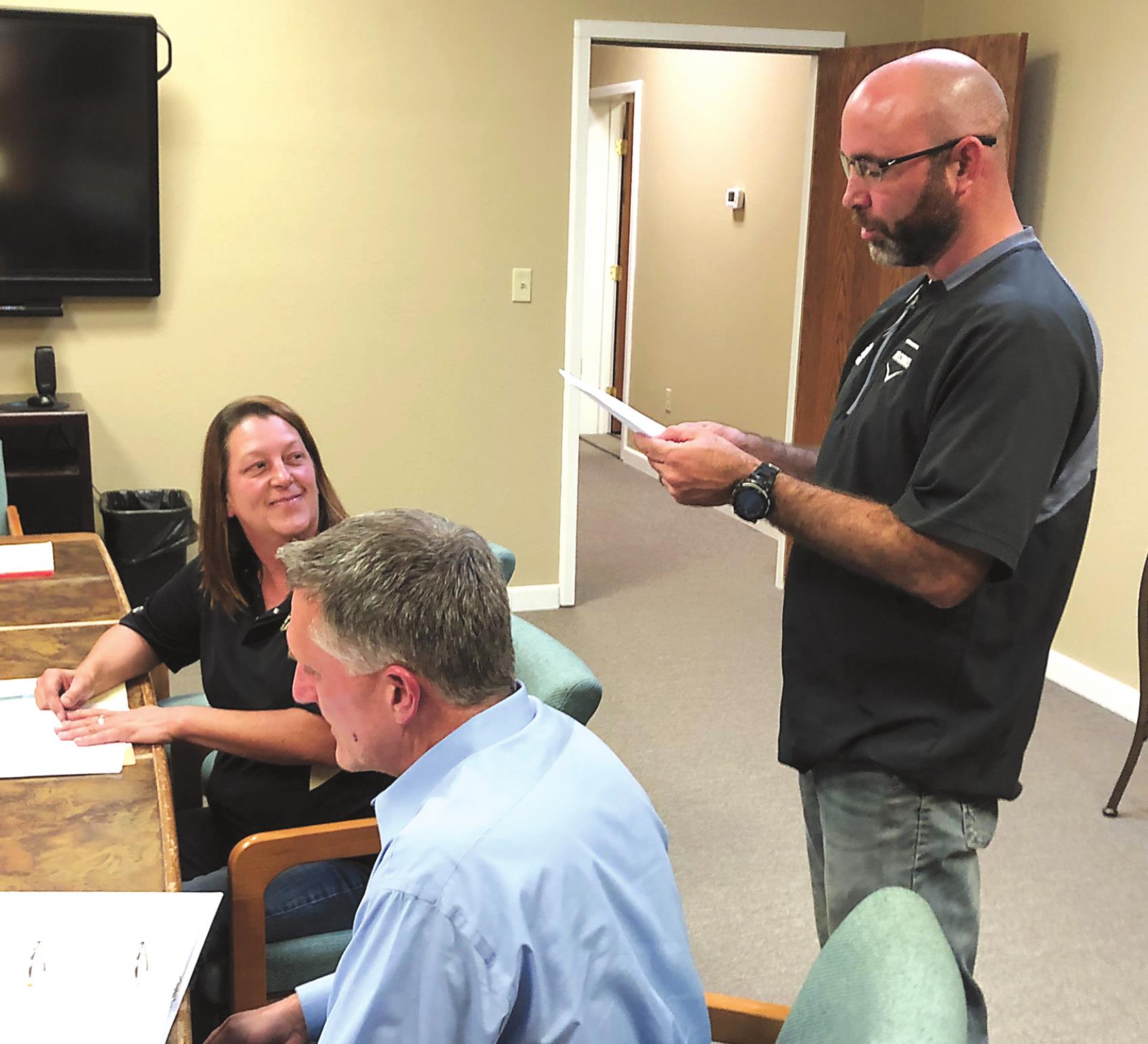
Allen School Board President Jeff Maloy retired from the board Monday night after serving for 10 years. He made an official announcement at the board’s regular meeting during action items.
“I’ve enjoyed my time on the board,” Maloy said, “and I think we’re in a good spot with the people we have in the administration rolls. And, things are going good, so I think it’s a good time to let somebody else have a run at this thing. Like I said, I enjoyed everybody, I enjoyed my time. There were some hardships sometimes, but for the most part, it was a good experience. I’ll cherish it for a long time.”
After the announcement, Superintendent Jeff Hiatt
Hiatt thanked Maloy for his service and mentioned that his 10 years on the board was a long time and commended him and people who give up their time to serve.
“Whether a church, a school, anywhere,” Hiatt said.
The plaque read: “Presented To Jeff Maloy In Appreciation for Your 10 Years of Outstanding and Dedicated Service to Allen Public Schools as a BOARD MEMBER. October 12, 2020. Presented by Allen Board of Education, Administration, Faculty, Staff and Students.”
The board accepted Maloy’s resignation, then appointed Frankie Bell to the vacant school board seat (Office Number One) and administered the oath of office.
Bell read the oath, then took his seat at the table. He will remain in the position at least until the annual school board election, which will be held next year.
Afterward, reorganization of the board took place, which is standard procedure after a vacant seat is filled. Reorganization will also take place again after the election.
Board member Ron Batey made a motion to appoint board Vice President Jami Rinehart to serve as board president. Rinehart abstained from voting, and received unanimous yes votes.
Rinehart then nominated board member Kelly Hurt, who was absent from the meeting, to serve as vice president.
“Again, that’s what he gets for not being here,” Rinehart said lightheartedly.
The board approved. Rinehart then nominated Batey for board clerk, formerly held by Hurt, which the board also approved.
Action Items
In other action items, the board approved adding the board president’s and board clerk’s signatures to the Farmers State Bank signature card.
The board also approved a resolution calling for the annual school board election, with the seat to be filled being Office Number One; the deregulation application for Library Media Services elementary and secondary personnel as presented; Joni Hill as a mentor teacher for Devan Bettencourt; and set up residency committee.
Administrative Reports
Administrative reports were delivered by Hiatt and Elementary School Principal Amy Mayhue. High School Principal Chris Grimm was absent.
Mayhue began by speaking about enrollment.
“We’re sitting at about 249 students, that’s 3 year olds through fifth grade,” she said. “I started out the year with about a little under 50 virtual kids, I am down to 26. They have returned, the majority have returned. The biggest number I have right now, believe it or not, is kindergarten and fifth grade.”
Mayhue said most teachers are handling it well and, on average, have about three or four virtual students that they are responsible for.
When Hiatt asked how the kids who are returning from virtual learning are doing, Mayhue said the kids were fitting in, but were behind.
“Everyone who started at the beginning of the year was behind, but we all knew that was going to happen as they lost nine weeks of school,” Mayhue said. “But the kids who have been out a little bit longer, they’ve been out of the routine. So when they come back in, they’re a little bit behind, but we’ve been able to kind of pull them right back in. I told the parents from the git-go, ‘I put those kids in a class. Your child is assigned to a class, this is your child’s teacher. If you decide to come back, you are a part of that classroom.’ And so there’s been a real smooth transition, their friends are in there, and they’ve moved right in and they’ve started work.”
Mayhue said what is difficult for teachers is the fact that the curriculum from virtual learning to the classroom doesn’t always coincide.
“Now, for science and writing, we’ve been able to do that,” she said. “But for reading and math, they’re working through the program doing their learning path, and theirs is going to take them a different way than what the teacher’s doing in the classroom. So, that’s been a little bit of a struggle because there’s some gaps that they’ve missed, instruction, our teachers have to go back and fill in those gaps.”
Mayhue said that the elementary school has implemented reading interventions at all grade levels. Instructional intervention is a specific program or set of steps to help kids improve in an area of need.
Mayhue said she has also implemented a brand new phonics program -- a method of teaching students to read by correlating sounds with letters or groups of letters in an alphabetic writing system.
She said they are going to see that every student gets it every day in pre-k through second grade.
“And then two of our intervention groups are teaching phonics in third grade to fill some of the gaps that our second graders coming up to third have,” she said.
Jeff Hiatt
Hiatt said Allen enrollment is down, but enrollment numbers are down all around the county, due to virtual schooling. He also mentioned how many days the school has enjoyed without a case of COVID-19 -- none this school year.
“This is our 40th day of being up here at school without any COVID cases,” he said, “we haven’t had any yet. Am I naive for thinking that we’re not? No, it’s just a matter of time, it’s going to happen. We’re going to get a case. And I’ve been waiting for 40 days to say, ‘Okay, this is what we’re going to do,’ and I haven’t had to do it yet, which is good.”
Hiatt said as far as the mask/no mask debate goes he mentioned Allen isn’t requiring masks and hasn’t had any cases while a nearby school which requires masks has had many cases.
“So you can take it for what that’s worth,” he said.
Hiatt spoke about virus protocols, which haven’t changed due to the system not having had any cases.
“I tell people all the time, if we have a breakout in Allen, or at school, that could change,” Hiatt said. “I mean, we’re still to the point like, if we have a breakout in the cafeteria and I lose my cafeteria staff, we’re not going to be able to have school, I don’t have anybody that can cook meals. So that’s kind of like my number one worry is my cafeteria ladies.”
Hiatt said the situation with masks can be argued, but the main thing is the social distancing.
“It’s hard to do, but I mean whatever we’re doing, the health department lady called me last week and said, ‘You’re the only school left (in the county without a case), whatever you’re doing, just keep doing it.’”
Hiatt spoke about the upcoming basketball season, and that protocols will have to be in place for indoor events.
“What I’d like to do for our gym, since the season is a month away, I want to see what everyone else is doing,” Hiatt said. “One thing I would like to do is, it will be easy to do, is have the home side, and the visiting side. So like if the visiting team wants to come into our gym, you know they can stay over on their side. A lot of the schools aren’t doing concession stands, some are doing concession stands. I really don’t want to jump in and change all that right now because I don’t know what two, three or four weeks out is going to be yet.”
Hiatt mentioned a new baseball scoreboard.
“The bank, I want to thank Debbie Rinehart (who), is donating enough money to buy us a really nice baseball scoreboard,” he said.
Hiatt said the money from the bank will pay half the cost of a new scoreboard, and the other half is coming from donations which will be announced at a later time.
The new scoreboard will be larger than the current one, which is small, Hiatt said.
“This one will have the runs by inning,” he said.
Johnson - O’Malley
Indian Ed Director Greg Mills spoke to the board concerning the Johnson - O’Malley Act before the board approved the adoption of Indian Education Program Policies and Procedures for fiscal year 2021.
“The funds that are made available to the Johnson - O’Malley Act which provides supplemental services to certified Indian students of a quarter or more of Indian blood or any members of their federally recognized tribes qualify,” Mills said. “Programs are designated to meet the unique educational needs this specific population in our area. An Indian education committee, composed solely of parents of qualified students participate in program development, implementation and evaluation each year. The BIA (Bureau of Indian Affairs), on a contract basis with the school district, administers the funds. We have approximately 150 students per year that go through JOM. We have a committee of five people, and we have evaluation forms that we send out yearly, so they can tell us what they like, what they don’t like, what they feel like we need and we adjust according to what they see. It’s a good program, a very good program. The main educational needs that we’re meeting with our students right now in JOM deals mainly with school supplies, ACT testing, and caps and gowns.”
Consent Agenda
The board approved the consent agenda which included the fiscal year 2020-2021 purchase orders and encumbrances: General fund numbers 145 through 161 ( $48,635.50 ); building fund numbers 42 through 45 ( $2,690.74 ); the treasurer’s report; and activity fund report.
The agenda also included an FFA trip to Panhandle State on Nov. 10-11; and a fundraiser for junior class, girls basketball and boys basketball.