
COUNTY COMMENTS
Quote of the Week: “One of the great things about growing older is that the things you buy won’t wear out.”

—CC—
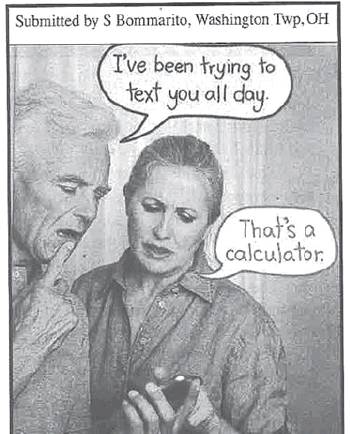
Although I do not text, many of my friends do. In fact, more and more seniors are texting and tweeting, so there appears to be a need for an STC (Senior Texting Code). If you qualify for senior discounts, this is the code for you. Be sure to pass this on to your children and grandchildren so they can understand your texts.
ADT At the doctor’s
BFF Best friend fainted
BTW Bring the wheelchair
BYOT Bring your own teeth
CBM Covered by Medicare
CGU Can’t get up
CUATSC See you at the senior center
DWI Driving while incontinent
FWBB Friend with beta blockers
FWIW Forgot where I was
FYI Found your insulin
GGPBL Gotta go, pacemaker battery low
GHA Got heartburn again
FWIPMK Forgot where I put my keys
HGBM Had a good bowel movement
IMHO Is my hearing aid on
LMDO Laughing my dentures out
LOL Living on Lipitor
LWO Lawrence Welk’s on
OMMR On My massage recliner
ROFL, CGU Rolling on floor laughing, can’t get up
TTYL Talk to you louder
WAITT Who am I talking to
WAP Where are prunes?
WWNO Walker wheels need oil
—CC—
As we have entered into a new year, I’ve been thinking of “Clean Curtains,” a Carl Sandburg poem that says a lot about both the promise and the challenges of cultivating virtuous habits.
New Year’s resolutions resonate as a national cause because we add to the broad health of society by fulfi lling them and becoming better people. Benjamin Franklin, as a variation of New Year’s resolutions, shared in his autobiography his systematic program for cultivating 13 basic virtues, including frugality, industry and humility—seemingly advancing them as an important form of social capital for a young country on the move.
But what happens when society seems to be decaying, regardless of individual efforts towards personal improvement? It’s a question that comes to mind a lot these days given the disconnect many of us feel with popular and political culture. In a country so divided and coarsened, does one person’s private struggle for moral purity really matter?
Such a dilemma rests at the heart of “Clean Curtains,” Sandburg’s seemingly simple poem about a family that moves to an urban neighborhood near the dawn of the 20th century. “The look of their clean white curtains was the same as the rim of a nun’s bonnet,” Sandburg tells readers, his imagery framing cleanliness as something holy.
This small act of dignity is assaulted by the general filth of the city. The dust of passing traffic from nearby factories quickly soils the curtains, which the lady of the house tries to keep spotless. Eventually, though, the family gives up and takes the curtains down: “Dust and thundering trucks won—the barrages of the street wheels and the lawless wind took their way.”
“Clean Curtains,” which appears in Sandburg’s 1920 collection, “Smoke and Steel,” is about many things, but principally the death of idealism. He wrote the poem at a time of vast and sometimes alienating social change, a period not unlike our own. At first glance, those soiled curtains of Sandburg’s poem can seem like an acknowledgment that in a big, mean world, tiny gestures of goodness won’t make much of a ripple.
But the poem itself speaks of something more hopeful. That someone witnessed those disappearing curtains and recorded their absence is a statement of resolve. It’s a declaration that an individual voice, a single deed, a lone life cultivated to seek health and beauty and brightness can be a blessing to mankind.
That’s reason enough for each of us to resolve at the start of a new year to be better somehow. It’s a way to hang clean curtains in a bruised and darkened world—what Sandburg, perhaps thinking of a new year, called “white prayers in the windows.”
Danny Heitman
WSJ
Here is the actual poem talked about in the above article.
Clean Curtains
NEW neighbors came to the corner house at Congress and Green streets.
The look of their clean white curtains was the same as the rim of a nun’s bonnet.
One way was an oyster pail factory, one way they made candy, one way paper boxes, strawboard cartons.
The warehouse trucks shook the dust of the ways loose and the wheels whirled dust—there was dust of hoof and wagon wheel and rubber tire—dust of police and fire wagons—dust of the winds that circled at midnights and noon listening to no prayers.
“O mother, I know the heart of you,” I sang passing the rim of a nun’s bonnet—O white curtains—and people clean as the prayers of Jesus here in the faded ramshackle at Congress and Green.
“O mother, I know the heart of you,” I sang passing the rim of a nun’s bonnet—O white curtains—and people clean as the prayers of Jesus here in the faded ramshackle at Congress and Green.
Dust and the thundering trucks won—the barrages of the street wheels and the lawless wind took their way—was it five weeks or six the little mother, the new neighbors, battled and then took away the white prayers in the windows?
—CC—
Most of us senior citizens like a “bargain”. However, Helen Self got a really great bargain!
A generous birthday discount offer at a Montana restaurant was taken full advantage of by Helen Self, who wound up getting money back after celebrating her 109th birthday.
The Montana Club in Missoula runs a birthday promotion for its customers that comps a percentage off from meals based upon their age.
A 63-year-old will get a 63 percent discount, a 100-year old will receive a 100 percent discount—but what happens when a diner is 109?
Helen, Montana’s oldest living person, had that one all fi gured.
“Once she turned 101 she informed me that I had to come in and pay her for her meal,” said owner of the Montana Club, Nick Alonzo.
This year, she received 100 percent off her meal as well as the 9 percent back I cash from Alonzo.
—CC—
And last of all my favorite story of the week . . .
After a long, dry sermon, the minister announced that he wished to meet with the church board after the service. The first man to arrive was as stranger.
“You misunderstood my announcement. This is a meeting of the board,” said the minister.
“I know,” said the man. “If there is anyone here more bored than I am, I’d like to meet him.”