
Allen School Board discusses opening
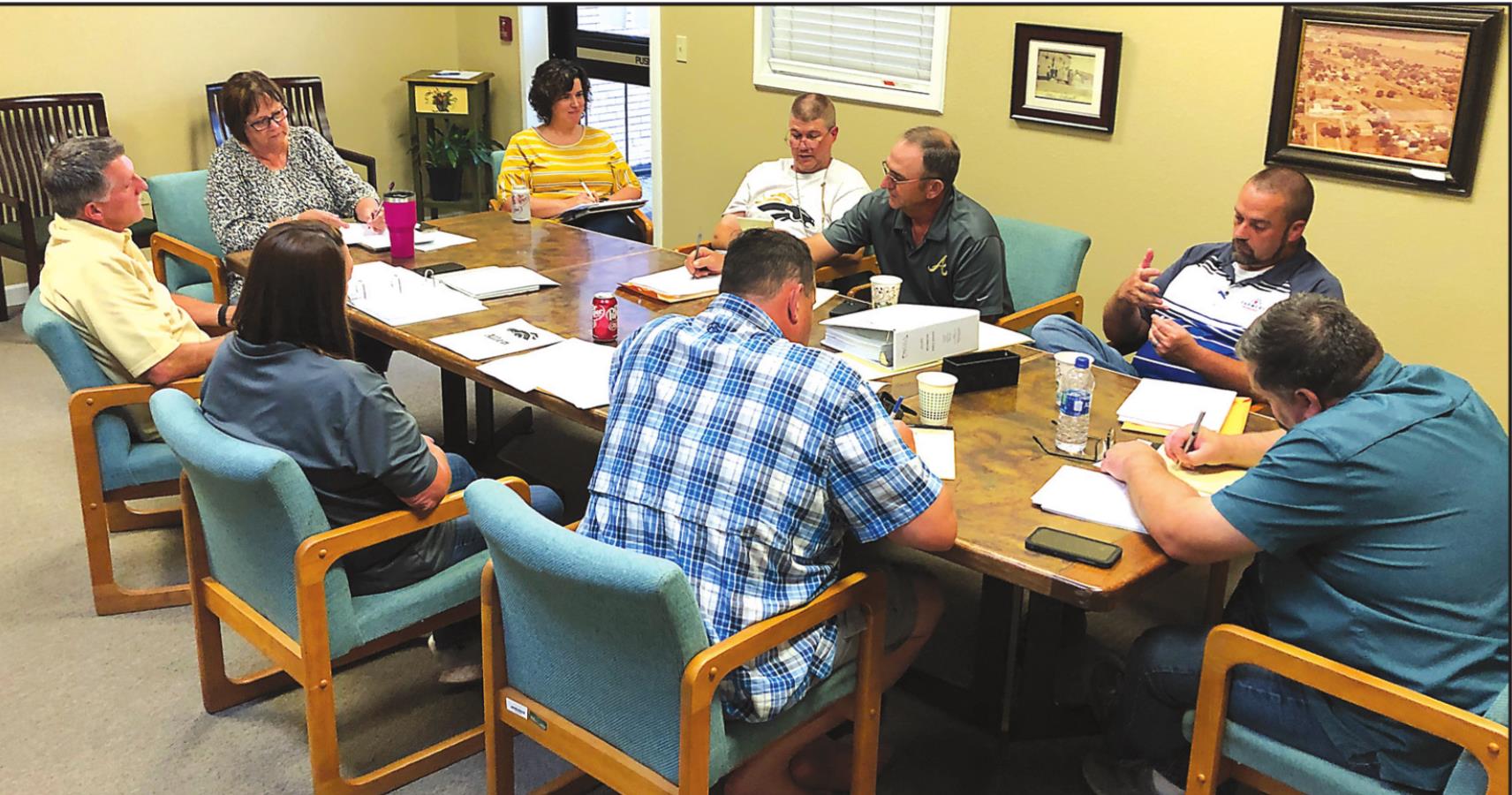
With one week before the first day of the 2020- 21 school year, opening Allen schools amid the COVID-19 pandemic was the number one topic of discussion at Allen School Board’s regular meeting held August 13 th .
There was also discussion about schools electing to postpone the opening of school for two weeks. Some school systems, such as Konawa, began school, then decided to take a two-week hiatus after a couple of students tested positive for COVID-19.
Administrative Reports
Administrative reports were delivered by Superintendent Jeff Hiatt, High School Principal Chris Grimm, and Elementary Principal Amy Mayhue.
Hiatt began by saying that when school starts August 20 th (today), it will have been 161 days since the kids were in classes.
“So that’s exactly 23 weeks that we’ve been out of school,” he said.
Hiatt said there is some concern with such a long break in the process.
“Most of the kids I’ve seen, most of the parents, they’re ready for us to get back to school,” Hiatt said. “I just want to make a commitment, I’ve been telling everybody that we’re committed to do everything we can to keep this school safe for our kids, and for our teachers. Honestly, the teachers are way more at risk than the kids, so we’re trying to address their concerns (as well). But we’re also committed to keeping the doors open.”
Hiatt spoke about precautions Allen Schools will be taking and what steps will be taken if a student tests positive for the virus.
“What we’re trying to do is keep our social distancing,” Hiatt said. “We’ve got seating charts. A lot of kids won’t like it, but if we do have a positive case, we need to trace who that kid’s been around. What the health department’s been telling us, we’ve been working closely with them, the main thing that they’re going to look at is, if there is a positive case, who was that person around the previous two days for more than 15 minutes.”
Hiatt said the Centers for Disease Control and Prevention continues to relax its recommendations.
“So that kind of squelches the hallway thing, kids can go in the hallway,” he said. “If they’re in the hallway, they’re not going to be close to each other for more than 15 minutes together.”
However, Hiatt mentioned that they were still trying to work out the precautions which will be taken at the lunchroom as the kids will be around each other for more than 15 minutes.
“So that’s some of the stuff we’re doing here,” Hiatt said. “If we do have a positive case, in my mind, it’s probably going to happen, we’re not going to overreact, we’re going to call the health department, do the contact tracing and notify all parents that has someone that we feel like fits that category where we’re probably going to recommend quarantine, and then let everyone know that we have a positive case. So, just because we (might) have a positive case, doesn’t mean we’re going to shut it all down.”
Hiatt emphasized that the identity of a student who tests positive for COVID-19 will be kept confidential.
Hiatt said if parents still don’t feel safe sending their kids to school, it will be their option to keep their child home and there will be no punishment -- as in absences will be excused.
Questions arose from board members which included how will the school know if a kid tests positive.
“Someone will have to call and tell us,” Hiatt said.
“So, we’re relying on the parents to tell us,” Board Clerk Kelly Hurt asked.
“We are,” Hiatt responded.
Hurt asked about students the parents of which won’t take the child for testing, but the school suspects may have the virus.
Hiatt said if a child has a fever, or other symptoms of the virus, they must then quarantine for 10 school days, whether they go and get tested for COVID-19 or not.
Hiatt said a student who must quarantine will automatically go to distance learning.
Hurt asked about the taking of temperatures, to which Hiatt responded that Allen Schools will rely on parents to check the temperatures of their kids each day before sending them to school. The school will not check the temperatures of every student every day, but the schools will take a child’s temperature if they are suspected of being ill.
Hiatt said the school will be working closely with the health department,
Continued Page 3 however, he stressed that the health department will only make recommendations. The school will then decide what occurs after that.
“I want to thank my principals, because they’re going to be on the front lines with the teachers doing all this,” Hiatt said. “There’s a lot of changes, and, you know, nobody likes changes, especially teachers. There’s just going to have to be a lot of changes this year to just kind of get everything ready for them.”
Chris Grimm
The subject of virtual schooling was brought up, and what would occur if a child must stay home.
Hiatt said the schools must provide Wi-Fi hotspots if a family can’t provide internet for their kids (for virtual learning).
“We ask them to use their own internet,” Hiatt said. “If they use our hotspot, then we control their (virtual learning) internet. It goes through our filter system, we see everywhere they go, everything they do.”
Grimm said the schools’ devices -- Chromebooks -- are the only ones that can hook up to the hotspot.
Hiatt said the schools can also make it to where students can’t surf the web, just visit what sites are allowed. He also stressed that the amount of hotspots which can be provided will be limited.
“We just can’t provide a hotspot for every kid,” Hiatt said. “It’s $20 a month (for each hotspot).”
Hiatt said they tested two providers with hotspots, U.S. Cellular and T-Mobile, and he prefers T-Mobile.
“You’re right, over in your neck of the woods U.S. Cellular is worthless,” Hiatt said, “but T-Mobile worked real well. Basically, we drove the bus routes of every kid, we stopped in front of (the driveways) and tested them.”
Hiatt said not only did T-Mobile’s capability outperform U.S. Cellular, but at $20 each, it’s half the price of the other company.
Grimm spoke about Chromebooks.
“As far as sixth through twelfth (grades), we have the Chromebooks to go one to one,” Grimm said. “I mean, already in place. There’s policy in there for that, for the students to take these Chromebooks home, and I hope they take them home every day. So that if we do have an outage, ... then they’ve already got it at home to make their life a little easy on this. We’re going to get to looking at protectors to go on these things. There’s going to be an insurance involved with this. And, it kind-of phases out on the third incident. If they intentionally damage it, they’re paying for it, period. There’s no question about that. But if it gets lost, stolen, they’ve got to have a police report in the works. And that’s all in that new policy we’ve got in there.”
Hiatt said each Chromebook costs about $200, which he emphasized doesn’t sound expensive, but when the school system is purchasing them for 200 or so students, it does become expensive.
“So, there’s not a socalled insurance company out there that insures them,” Hiatt said. “... So like, what we’re going to propose, we’re going to ask the kids to give us $20 insurance. That will cover the first, if something happens to your Chromebook, we’ll take your $20 and we’ll fix it. But there’s different steps. But that money’s not returnable, you’re paying $20 for using the Chromebook. And then, what we’re going to do with that money is basically fix broken Chromebooks. That’s the insurance.”
Amy Mayhue
Mayhue began by speaking about the numbers of students in Allen Elementary.
“We are looking at a total of 255 students in elementary,” she said.
Mayhue said enrollment in many Headstart programs around the state is lower than usual.
“We are very fortunate,” she said. “Some of the Headstart programs are very low this year. Some of them, the classes are like five (students), because parents are just deciding not to send them, and instead just keep them home.”
Mayhue said Allen’s Headstart numbers are good.
“We’re going to have about 13 in each class for 3 year olds,” she said, “and about 11 and 14 (in each class) for 4 year olds. So we’re a lot higher in Headstart than some of the other schools, so that’s good. Every grade has some virtual kiddos. I have 36 total right now. My high one is kinder. Kindergarten is my high group of virtual kids.”
Mayhue said there are about eight kindergarten students in virtual learning.
“That, to me, is a little scary,” she said. “To help with this, I’ve come up with a plan that’s a little bit out there, and not everybody’s really going here. ... It’s going to take some time because it’s not going to happen right at the beginning, but what I’ve tried to encourage my pre-k and my kinder virtual teacher, what I’ve tried to encourage is they’re going to be videotaping their lessons pretty much every day, to be able to put out the circle time to the parents. I want to eventually open it up, if I can get the technology in place and I can get waivers from parents to sign, I’m going to try and livestream their circle times in pre-k and kindergarten. Mainly because I want those pre-k students interacting with the kids who are here (in the school).”
Mayhue indicated that there are a lot of multigenerational homes where there is a fear that a child may get sick, then bring home an illness to a grandparent.
“I’ve talked to every single one of these virtual parents personally,” Mayhue said, “and they all have a reason, and I’ve found that most of the reasons they’re giving me are completely 100% valid. And I support them in this decision. It’s not what I want, I want them here, I want them with their teachers, but I also respect their decisions.”
Mayhue said a question that arises often is, “Are you going to make my kid wear a mask?”
“I say, you know what, that’s your personal choice,” Mayhue said. “We highly recommend it, but the one thing that I’ve said to my teachers, and I will say again on Monday when I meet with them, is I want them to teach our kids to respect others, no matter what it is. So if a child in a classroom has a mask on, we’re going to talk about it. And we’re going to say, ‘Why is that child wearing that mask?’ And we’re going to respect that child for that decision and that family that decided that that is what their child needed to do.”
Consent Agenda
The board approved the consent agenda which included the minutes from the July 13, 2020, board meeting; the fiscal year 2020-2021 purchase orders and encumbrances: Fund 11 -- general fund numbers 108 through 120 ($22,219.75); Fund 21 -- building fund numbers 27 through 32 ($5,688.75); Fund 22 -- child nutrition fund numbers 28 through 30 ($28,804.50); Fund 33 – 2017 construction bond fund numbers 3 and 4 ($6,600.00).
The consent agenda also included the treasurer’s report; activity fund report; a contract agreement for Career and Technology Education Programs Allocations (Ag Education, Business and information Technology Education and Family and Consumer Sciences) for the year ending 6/30/2021; fundraiser requests – athletics, baseball, cheer, FCCLA, FFA, girls basketball, powerlifting, fast pitch softball; committees for fiscal year 2021, including Gifted and Talented, Professional Development, Safe School and Healthy Fit, Reading Sufficiency, Title I and Title IV-A.
Action Items
The board approved all action items which included approving the Allen Public Schools Distance Learning Plan; approving the Allen Public Schools 1-to-1 Chromebook Policy and Protection Plan; approving new board policies as provided by OSSBA: ECA, FB, FB-E1, FB-E2, FB-E3, FDCP, FJ, FJ-E, FJ-P, FJ-R, FMAAA; updating board policies as provided by OSSBA: DABB, DMB-R1, EHDF, FDC-R1, GK; approving the student handbooks for fiscal year 2021; approving the fiscal year 2021 Oklahoma state minimum and Allen salary schedule for teachers; teaching assignments and class schedules for fiscal year 2021; approving Chad Colbert as adjunct teacher for 7 th grade geography for fiscal year 2021; approval of Allen Public Schools taking the ACT as the locally selected, national recognized assessment for the College and Career Readiness Assessment (CCRA); the purchase of cheerleading uniforms; opening a JH cheer activity account, approve fundraiser requests and expenditures, and transfer $500 to JH Cheer activity account from HS Cheer activity account; and adding Kelly Hurt, board clerk, to the signature card at Farmers State Bank.
Executive Session
The board entered into executive session, and, upon returning, accepted the resignation of Mike Edwards, head baseball coach and assistant softball coach, who accepted a position at Ada Schools.