
Allen’s Oil Boom 1912

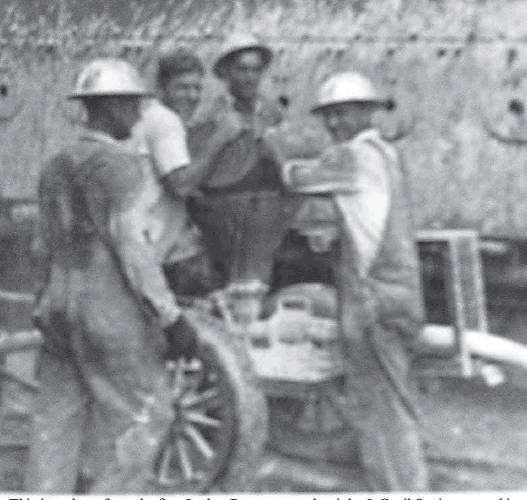
Prior to the oil boom in the state, Allen businessman and promoter, M. B. Donaghey reported that the first oil well in the Allen area had begun drilling in September 1912, and then another on the Banks Roberson place, followed by the Gilmore wells on the river. Soon, the Allen fi eld spread to the west and north and later included 150 wells. Additional wells began production three years later in the Francis Pool. The ‘Allen Hustler’ reported that “the big eyes of the oil world were focused on Allen.”
By the early 1920’s there was enough production in the area for the Oil State Company of Enid to construct a small refinery west of Allen. Another was constructed in the Francis area. In order to facilitate better mobility of citizens and transport of equipment, the construction of a gravel highway from Ada to Allen was assured with matching funds from the federal government in June, 1920. Specifi cations called for a new road eighteen feet wide with a gravel depth of nine inches.
By January 1923, there were about 200 producing oil wells and nearly twenty gas wells in Pontotoc County, with an additional twenty five wells to be drilled by the end of the year. The Allen fields were the largest producers of oil operated by Tidal Oil, Texas Oil, Prairie Oil, Homa-Okla Oil, Humble Oil, Lawrence Oil, Great Lakes Oil and several smaller oil companies. The increased prices of oil contributed to the drilling boom and Allen’s economy surged. Businesses thrived and optimism spread, but the downside of the infl ux of workers was the housing shortage for a while.
Two refineries in Allen operated at full capacity. The Mecca Refining Company was in operation with F. L. Martin as superintendant. The Oil State’s plant was under the direction of R. L. Johnson. A. Dewey Vinson began working with Oil State in 1921. But, by 1926, the boom had taken a downward turn and many families left the area. A new ‘discovery’ deeper well was brought in which created another boom.
On July 11, 1928, The Allen Democrat reported that Allen was to get a $250,000 oil refinery, stating “This county has made a start towards utilizing the resources bestowed by a bountiful nature and in time will be dotted with manufacturing plants that are turning raw materials into the fi nished product.”
The history of the refinery began in 1918 with the Chrystal White refinery, with Floyd L. Martin serving as assistant superintendant. That refinery was later known as the White Oaks refi nery, which became the Homa-Okla refinery of which the 1928 announcement referred to. This was a life saving announcement for many workers in light of the state of the nation’s economy at the beginning of the Great Depression, that would last ten years.
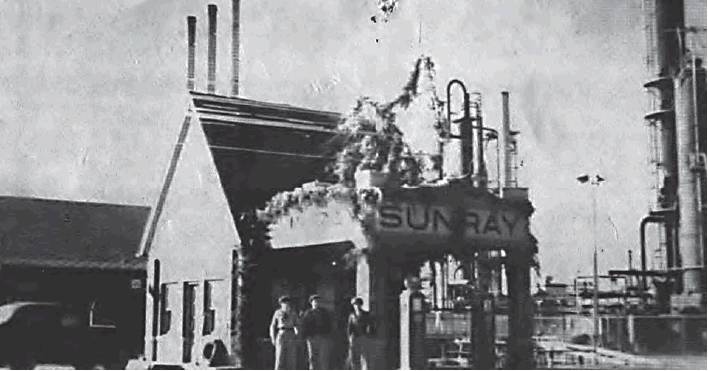
In 1930, the Homa-Okla refinery was purchased by the Sunray Oil Company. Employment shifts from other plants to Sunray in the next few years improved the plant under the direction of R. L. ‘Dick’ Johnson, the general superintendant and Arthur Dewey Vinson, who served as assistant superintendant. In 1926, Floyd Martin had moved to Sunray and was vice president in charge of the refinery and the sales department. The first addition made under the new operator was a distillation unit, and with the addition of tanks and other equipment increased the refining capacity to about 6,000 barrels of crude a day. By the end of the decade, the Sunray refinery was a state of the art facility for its time. In May 1939, Dick Johnson reported that over 800 tank cars of oil products had been shipped over Allen’s only railroad, the K. O. and G.
Sunray headquarters for the production department was located about three miles west of Allen on the Francis Road. There was a large warehouse, supply house, extra equipment and machinery as well as residences for employees all in a park like, well maintained setting. Sunray’s success can be attributed to their skilled employee work force of about 100 employees by the early 1940’s, averaging 70 employees year round. Few labor problems existed with the bulk of workers living in the Allen district and wages were high or higher than other plants in this section of the state. Payroll for the Sunray plant averaged about $13,000 per month. Good wages and solid employment meant a stable future for their employees and they planted roots for their families in the community.
An employee publication, The Sunray News, had the following Allen news in 1939: “Among the longtime home owners of employees of the Sunray refinery at Allen are A. A. Milne and C. D. Taylor who live across the street from the plant. Hack Jones is also one of the first home owners in Allen, as is Leon Jones. E. G. Smith owns his own home and specializes in raising bees; the George Watson home is famous for its fl owers and shrubs; H. C. Kraettli specializes on raising hogs on his miniature farm east of town; still farther east Jimmie Bland has an orchard and garden on his acreage. Clarence Hampton built his own home about two years ago, and Murray D. McCormick has been in his home two years also. Bob Richards has been moved into his new home for a year, and a home was recently purchased by Luther Jones. One of our largest home owners is Holly Everett, who has three, but rents them all. Superintendant Dewey Vinson spends his leisure time on the farm outside the city limits and Superintendent Johnson also has a farm near Allen. Clay Holybee remodeled his home about a year ago; Tom Mays bought an additional lot near his home and is doing some remodeling; as is Morrisen Whitt, and Donald Stout contemplates reconditioning his home in the near future. Pete Bouchillon is in the midst of remodeling his home and takes special pride in his wood burning fi replace.”
From the beginning, the Allen refinery was the mainstay of the community. Oil production records were broken for continuous operation and high employment. Accidents were uncommonly low with only nine accidents in the first nine months of 1939. The Great Depression was coming to an end and life was good. But then, on December 8, 1941, the day after