
Allen’s Oil Boom
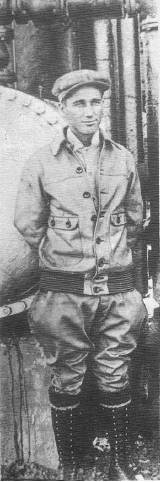
Japanese forces attacked Pearl Harbor, the United States declared war on Japan. All refineries operated at full capacity for the war effort.
After the end of the war, on August 19, 1947, Sunray Oil Corporation announced the purchase of the government’s wartime gasoline products refi nery near Duncan, Oklahoma for 5.1 million dollars. The deal had been accepted by sealed bid. Associated Refineries, Inc. operated the plant during the war, at an original cost of fourteen million dollars. Sunray announced they planned to remodel and upgrade the plant, and construct a 93-mile six-inch pipe line between the Allen refi nery and Duncan.
For the next two years, operations between the two plants continued. In November 1948, a major accident at the plant occurred, when a chain broke on the hoist of an elevator when three men were working on a hot oil burner. John Bland, Morris Stick and Sidney Long were injured in the fall. Sid Long received the most serious life-threatening injuries requiring months of recovery. Accidents began to plague the workers.
In October 1949, it was reported that the Allen plan would shut down November 1st for “necessary clean out and repairs.” Another factor listed in the report was the failure of steel contractors to deliver tanks and pipe to take care of expanded markets in Allen. The report stated, “Resumption of operations at the Allen plant will largely depend on delivery of tankerage for product storage and development of more flexible operations in pipeline delivery. Sunray’s refinery at Allen has for the past two years been operated as an auxillary to the company’s 20,000 barrel per day catalytic cracking unit at Duncan.” Sunray announced that the Allen plant would continue to operate on a standby basis with a skeleton staff.
This was a devastating blow to the community. In December, T. L. ‘Tommy’ Tiernan, the refinery manager, announced that the Sunray Oil Corporation would pay Christmas bonus checks to all its employees laid off due to the shutdown of the Allen refi nery. The plant would operate on a standby basis with a small maintenance crew. F. L. Martin, who moved to the executive vice president position and head of the refining division said, “Despite a downward trend in the company’s overall operating profi ts during this year, the company’s director nevertheless voted the year-end bonus as extra employee compensation for the year’s work. Because of the termination of work at the Allen plant, we are especially happy to be able to do this.” The company held a special holiday dinner that year to honor those who served Sunray throughout their good years. Gold watches for twenty years of service were awarded to W. H. ‘Bill’ Daugherty and A. W. Tillery. Gold Sunray tie clasp medallions with a diamond inset were awarded to E. J. Dean, Carl F. Kile and J. H. Passmore for fi fteen years of service. Five year gold medallion awards were given to C. E. Brown, Jack Hammonds, W. A. Jestes, Elmer Moore, C. D. Rhodes, Jack Roberson, J. E. Roberson, T. T. Triplett, W. C. Vinson and Roy W. Jones.
There were many other long time Sunray employees. Some, but certainly not all, were John Bland, Virgil Dobbs, Bencil Dobbs, Paul Dodson, Holly Everett, Bob Gilmore, Harold Hammonds, O.D. Hammonds, Clarence Hampton, Wince Hensler, Tommy Hogue, Clay Holybee, Cecil Huckeby, Arthur Inman, Richard ‘Dick’ Johnson, Lee Roy Jones, Leon Jones, Luther Jones, Dutch Kraettli, Trelis Legg, Sydney Long, Elmer Martin, Tom Mays, Duke Milne, M. D. McCormick, J. H. McDonald, Arvil Nickell, Estill Nickell, Luther Patterson, Bill Pegg, Bob Pegg, Will Pegg, Homer Prentice, Garland ‘Dusty’ Rhodes, Bob Richards, Joe Rowsey, Arthur Ray Scroggins, Cleo Singleton, E. G. Smith, Floyd Smith, Cecil Spain, Morris Stick, Donald Stout, C. D. Taylor, Doyle Triplett, Charley Vinson, Dewey Vinson, James Vinson, Birch Walker, Archie Ward, George Watson.
Employees were offered transfers to the Duncan plant and many families left Allen. Other men commuted on a weekly basis who had established their families in local schools and on farms. It was a hardship for many families and the business community suffered as well. The Allen Schools lost 54 pupils.
In 1952, although the future of the refi nery was bleak, Luther Williams, director of public relations for Sunray, spoke at a Rotary Club meeting praising the company and its future. In attendance was Tommy Tiernan, the last superintendent and his assistant, Duke Milne. In July 1953, there was a crushing blow to the refinery when a fl ash fi re at the plant threatened the entire installation. Although repairs were planned, the plant never fully recovered. In 1955, Sunray refi nery ceased operations in Allen, Oklahoma.