
1928 Bank Robbery in Allen
The More You Know
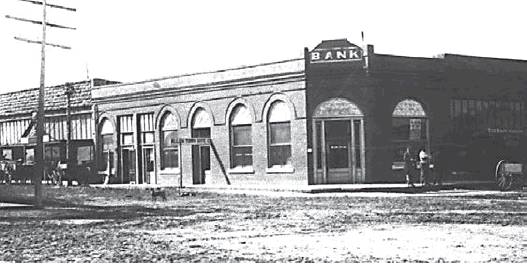
Long before the building on the corner of Broadway and Easton was home to The Allen Advocate, it was known as the First National Bank of Allen and one fine day in August of 1928 it was robbed. It was a typical warm summer’s day and townspeople scurried about attending to their daily tasks in town before breaking for their noon day meal at the nearby restaurants.
Allen was prosperous again after recovering from a damaging tornado in 1926, and a major fire that had destroyed a section of downtown the following year. Jim Jones, and his son J. I., had opened a new business, New Way Grocery, after the fire and new businesses lined the streets of Allen again. Banks and bankers were fl ourishing in Allen with the oil and farming industries providing an economic boon.
I.S. White, president of the First National Bank in Allen, had gone home for lunch, leaving Lorena Jones, the winsome assistant cashier, alone in the bank. Lorena was the new bride of J. I. Jones, who was married just the month before. About 12:30 p.m., two men dressed in oilfield worker’s clothing entered the bank and presented a check with a signature Mrs. Jones didn’t recognize. When she turned to check her files, the men brandished guns and came around into the cage. The twenty-three year old cashier was stunned, but complied with their demands to stand still, not scream or attempt to warn others. She later said, “I just simply complied with their requests. I felt little alarm after the fi rst few moments of surprise. I could scarcely believe the bank was being robbed, but I realized that because of the youth of the two men that any attempt of mine to prevent their taking the money would be hazardous.”
The men began to scoop up the money at hand and seemed agitated and nervous. Being disappointed at the lack of money at the window, one of the men wanted to see the vault. At that time, Louis Stewart, a bank employee and brother of Lorena, Evelyn Archer, a waitress at a local restaurant, and another man entered the bank. The disruption caused the robbers alarm. The robbers quickly gathered up what money they could, but overlooked some cash and silver coins in their haste. The bandits herded them into the vault and slammed the door, but it failed to lock. Strangely, the bolder of the pair peered back into the vault and told Lorena to take a good look at his face and remember him for the next time. The robbers fled the bank into an awaiting car, described as a Master Buick sedan. Lorena quickly escaped the vault and notifi ed authorities. Later that afternoon, a quick accounting determined that amount taken in the heist was about $2,500.
The news of the bank robbery spread quickly and it was learned that the robbers abandoned their car and stole another before heading towards the Seminole oilfields with a posse of offi cers and citizens on their trail. It was learned that the pair had spent the prior week in Allen, scouting out the town and the bank, allowing for perfect timing and execution of the robbery.
The State Bureau of Investigation joined local officers in the hunt. Tips from earlier robberies revealed the names of possible suspects.
On November 21, 1927, robbers hit the First State Bank in Stonewall, the beginning of a rash of bank robberies in the state. Stonewall became the unofficial bank robbery capitol of the county with two robberies recorded, and one at Roff.
A month after the Allen robbery, one suspect was captured in Tyler, Texas, transported to Fort Worth and then on to Ada. He was positively identifi ed by victims of other bank robberies, including Lorena Jones for the Allen robbery. His name was Curtis T. Black. Lorena Jones had no trouble identifying the man since he asked that his face be remembered. Black’s trial in Ada resulted in a guilty verdict in Judge Orel Busby’s courtroom, and he was sentenced to ninety-nine years in prison.
Black’s accomplice in the Allen bank robbery was William J. ‘Whitey’ Walker. Walker had a lifelong history of criminal activity and was in a Texas gang who robbed and murdered. During the late twenties and early thirties there were notorious gangs in Texas and Oklahoma, as well as in other states. Whitey Walker seemed to be a career criminal having been arrested, convicted and served time for crimes ranging from auto theft, burglary and felony theft, and often was released on bail and skipped town, or given short sentences or probation. His life in the bank robbery gang resulted in shootouts with police and the death of two policemen. Associates in the ‘Whitely’Walker gang included ‘Ace’ Pendleton and ‘Blackie’ Thompson, names straight out of a movie script. Whitey fl ed to New York where he was captured and returned to Texas for a while and then transferred to Ada for trial.
The jury found Whitely Walker guilty and when
issuing the sentence, Judge Busby said: “It is an unpleasant duty to have to pronounce sentence on you. But in a government like ours, the people make laws, which are the rules of conduct which govern our lives with relatio to fellow men. These rules by which we play the game of life, prescribe what is right and prohibit what is wrong. These rules safeguard the lives and property of the people. This marks the difference between civilized government and outlawry. When an individual starts out on a course of conduct defying the laws and making himself dangerous to society, then the law demands the penalty and says that the individual who takes this attitude be placed where he no longer is a menace to law abiding citizens.
“It’s too bad you started out on the wrong course in life. Your actions here in court and the information that comes to me about you, indicate that you are a man of intelligence, a man of action and of ability. If you had elected to enter the walks of business and played the game of life on the square and according to the prescribed rule, you could have succeeded in any line of business. Any man who, for any length of time, successfully lead a life of crime and evaded the law, can, and with the same energy and ability, make a greater success as a law abiding citizen. And a life of crime pays no dividends in the end. But on the other hand the criminal has to pay the penalty the law prescribes.
“You have had the benefit of a fair trial, able counsel to present your case, an intelligent jury to pass on it, and you have been found guilty. The law says that a man who takes a pistol and starts out to rob is a potential murderer. He expects to kill if he finds it necessary. If you had come into this court a fi rst offender, and plead guilty, asking the mercy of this court, and if you had a record of a clean life behind you, then I would have given you a light sentence, in the hope of reforming you. But your record and the facts in this case do not justify it. Both as a matter of punishment to you and as an example and deterrent to others who might be tempted to lead a life of crime, I feel it my duty to pronounce a penalty which will protect society from you in the future. Therefore, it is the judgment of this court that you serve the rest of your natural life in the state penitentiary at McAlester.”
During his imprisonment at McAlester, he was returned to Texas for trial and received a death sentence for his crimes there. During his incarceration in the death house at Huntsville, he and two fellow inmates planned an escape over the wall. Seven prisoners in all participated. Whitey Walker was the last to go, but he failed. He was shot and killed by prison guards in his attempt to flee, along with three other men. Three convicts made their escape but were soon captured and returned to the death house and later executed in the electric chair.
This story was excerpted
from an article by Sheila
Valpredo