
Country Comments
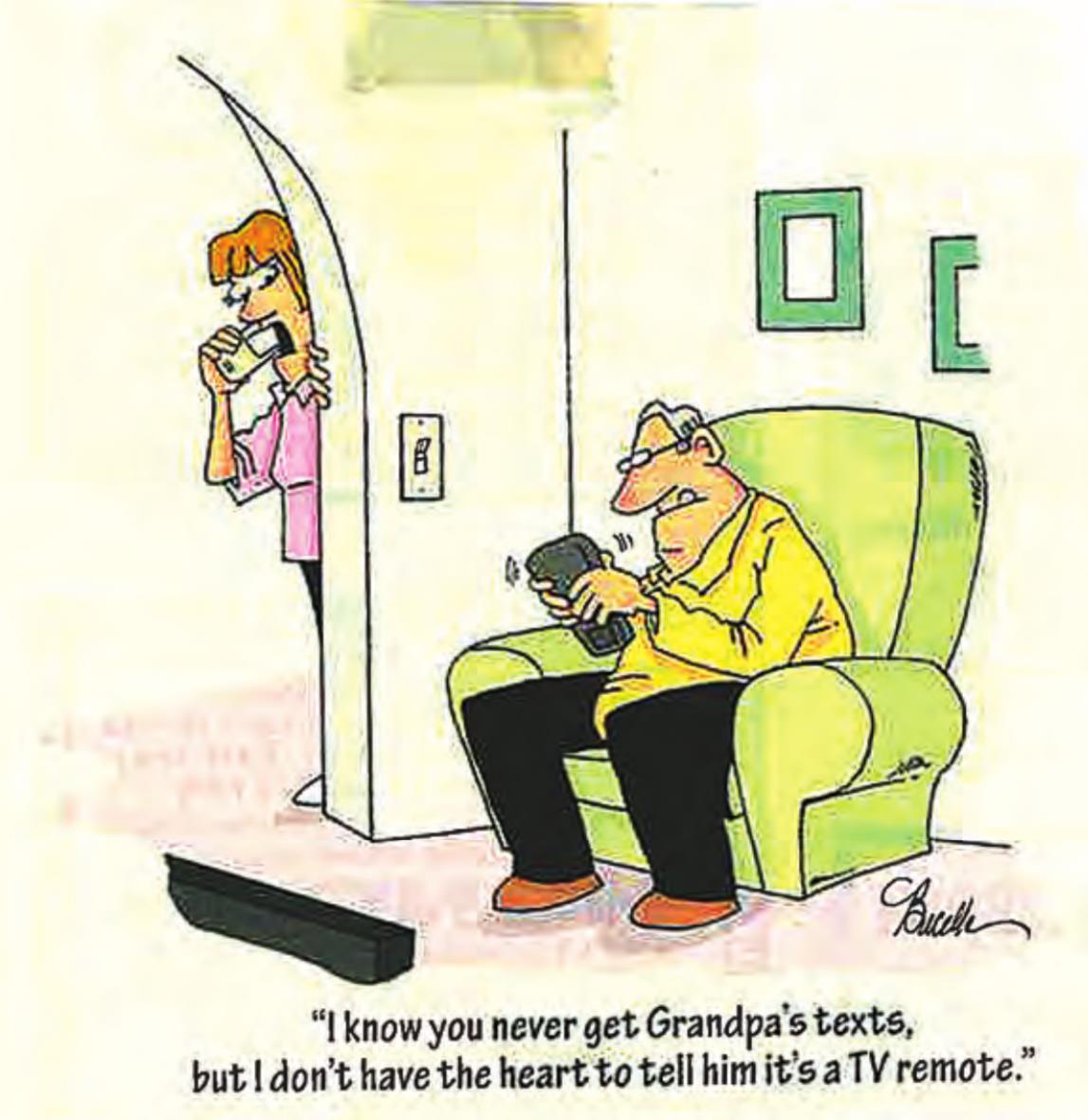
The young people have their texting codes . . . however little do they know that us ole timers have our codes also . . .
Since Youth of Today have their Texting Codes (*LOL*, *OMG*, *TTYL*, etc.) the Oldies decided to develop some of our own codes as well:
*ATD*--At the Doctor’s
*BFF*--Best Friend’s Funeral
*BTW*--Bring the Wheelchair
*BYOT*--Bring your own teeth
*FWIW*--Forgot Where I Was
*FACGU*--Fall and Can’t Get Up
*GGPBL*--Gotta Go, Pacemaker Battery Low
*GHA*--Got Heartburn Again
*TFT*--Texting from Toilet
*WHT*--What Hurts Today
*CRS*--I Don’t Know & Actually Don’t Care Anyway So Take Your Silly Problem Down the Hall to Someone Else Who Does.
Dr. Sidney Schmidt, Abilene Texas
And while we are on “computer” news….
There was a group of adults that were taking a computer science course at a community college. After a few weeks of classes, the professor decided to have some fun one day through a little learning activity. He divided the class by putting the men on one side of the room and the women on the other with these instructions: “I want you all to do a project for the next ten minutes. I want you to determine what gender computers ought to be . . .”
Let the deliberations begin. After ten minutes, the men, voted unanimously that computers ought to be referred to in the feminine gender. The professor said, “All right, share with me your points.” They had four (4) points. They said the reason why computers ought to be spoken of in the feminine gender are:
1. Because no one but their creator understands their internal logic.
2. Because when computers talk to each other, they communicate in code language that only they and experts can understand.
3. Because every mistake you make is stored on their hard drive for later retrieval.
4. Because as soon as you commit to one, these men said, you spend half your paycheck accessorizing it.
Now don’t laugh too hard, because the women have the last word on this subject.
The women voted unanimously, “Computers must be of the masculine gender”. Why? As the women gave their report, they said:
First of all, in order to get their attention, you have to turn them on.
Secondly, they have a lot of data, but still can’t think for themselves.
Thirdly, they are supposed to help you solve problems but half the time they are the problem.
And the final reason they gave was . . . as soon as you commit to one, you realize you could have gotten a better model.
Buffalo Gap News
All of the changes in the past few years have left some of us (me in particular) lost.
When I read the following article about Shakespeare I thought back to my high school English teacher Christine Provence and to my college professor Stanley Cameron. Could it be that King Lear might have a message for baby boomers?
Shakespeare’s Uncomfortable Message for Baby Boomers ‘King Lear’ confronts the challenges of the empty nest, retirement and facing one’s own mortality.
The scholar A.C. Bradley rendered a magisterial judgment in 1904: “King Lear” is Shakespeare’s least popular play—but also his greatest.
I’ve taught Shakespeare to college students for many years, and I can attest that “Lear” is both difficult to like and a profound work of genius. But unlike Bradley, who attributes the problem to technical issues of performance— he called the play “too huge for the stage”—I think its unpopularity is a function of demographics. Viewers and readers can fully grasp it only once they’ve passed 60, and by that point they may not like what it has to say.
In the opening scene, Lear decides to relinquish the throne and divide his kingdom among his three daughters. He asks only that each tell him how much she loves him before he bestows his gift. To my students, this scene seems ridiculous. Why would a father make such a demand of his children? Why would he want them to express their love in such a contrived way?
But for someone older, the demand makes more sense. It reflects Lear’s suspicion that his grown children no longer need him as they once did, and that their love, rooted in their childhood weakness and dependency, may have evaporated. His decision to give his daughters the kingdom could spring from a desire to win back the love he fears he has already lost. It may seem stupid for Lear to compound his vulnerability by giving away the only leverage he has left. Yet I think most parents would find his actions understandable. It is precisely when we feel unloved that we are most in need of reassurance, and thus most likely to behave irrationally. This is also why Lear believes the false expressions of love from his eldest daughters, Goneril and Regan, while banishing his youngest, Cordelia, who truly loves him but refuses to flatter him.
Few people are as credulous as Lear or have children as exploitative as Goneril and Regan. But Cordelia strikes me as a relatable case. She was Lear’s favorite, and he felt most confident in her devotion. Yet when pushed by her father to express her love, she simply explains that she loves him “according to my bond; nor more nor less,” and that some portion of her affection will be directed to her husband once she marries. This honest response— perhaps excessively honest—sends Lear into a rage. He berates Cordelia: “Better thou hadst not been born than not to have pleased me better.”
The line must resonate for many parents who invest so much in their children only to have them fail to show sufficient gratitude or, worse, respond with resentment. This is the great aftershock of parenting, and Lear is hit by it on two fronts: first with Cordelia’s muted response, and later with his other daughters’ cruelty once they no longer need him. In the former case, Lear is smug and entitled; in the latter he is, as he says, “more sinned against than sinning.”
If “King Lear” is a lesson in the unexpected results of child-rearing, it also dramatizes the vicissitudes of retirement. It captures the existential abyss that can open when a once-solid identity begins to melt, and purpose gives way to purposelessness. Lear is deprived of his retinue and thrown out into a storm, reduced to his most elemental self—a “poor bare, forked animal.” We baby boomers, aging amid a technological landscape that changes at dizzying speed, must sympathize. We, too, face a storm that can make even the most successful among us feel lost and diminished.
Lear rages at the ingratitude of his daughters and the crumbling of his regal identity, but these are ultimately stand-ins for a greater antagonist. Now on the downward curve of life, Lear faces the reality of death. Viewers and readers of the play can grasp this only when we reach the age when death, formerly hidden by the clutter of ambition and child-rearing, reveals itself.
At that point “King Lear” counsels us to moderate our expectations and sense of entitlement with regard to our children, to accept a diminished professional identity as we age, and to be philosophical in the face of our inevitable mortality. These are profound messages but not cheerful ones, which is why “Lear” is both a great work and an unpopular one.
By Paula Marantz
Cohen
Ms. Cohen is a dean and English professor at Drexel University.
Wayne Allyn Root spoke for many of us when he wrote the following: Why are Republicans and Democrats so divided over the coronavirus?
Obviously, we are a very badly divided nation: so divided we agree on virtually nothing; so divided we can’t even talk to one another anymore; so divided one side doesn’t believe in anything the other side says.
WE CAN’T even agree on how to respond to the novel coronavirus, and when to get back to business.
I have said repeatedly on my nationally syndicated radio show: “The business of America is business. It’s time to get back to work because the deadly virus is temporary, but the economic disaster we’re causing could last a lifetime and prove far more deadly in the long run.”
Many conservatives such as myself have also pointed out that the mortality rates of the coronavirus have been greatly exaggerated. On Thursday, Dr. Deborah Birx, “America’s Doctor,” said the same thing in a press conference: There will not be millions dead in the USA. The math doesn’t add up.
She reported how computer models predicting 500,000 dead in the U.K. have been downgraded to 20,000. She reported how the terrible death count in Italy just doesn’t add up to millions of Americans dead, not even close.
President Trump and Republican businessmen like me remain steadfast and optimistic that we can start bringing this terrible pandemic to a close and be back to business (or at least a limited business rollout) by Easter.
It’s not because we don’t take this pandemic seriously but because we believe in our hearts that we can’t allow the U.S. economy to die. We can’t allow another Great Depression. We can’t honor the sick or dying by losing our job, income and life savings. Someone has to mind the store, keep the economy going, pay the bills and pay the taxes so that after we win this war — and we will win — there is something for the older, the weak and the vulnerable to come back to.
We believe in our hearts and souls there is a way to restart this economy, and to do it carefully, reasonably and responsibly while protecting the oldest, weakest and most vulnerable.
Meanwhile, Democratic politicians and liberal Hollywood activists scream about millions dying and about keeping the nation locked down for months. And they call Trump and Republicans all kinds of terrible names.
What accounts for this difference? I believe I’ve figured it out. It’s all about personality.
MOST EVERY Republican I know is positive, outgoing and relentless, won’t take no for an answer and has can-do spirit. That’s why so many Republicans are successful in the business world. That’s why we’re proud to create the jobs and pay the taxes. We are the workers, makers and producers of America. We turn lemons into lemonade. We see the glass as half full, not half empty. We love working. We see it as our American way of life. We desperately want and need to get back to work.
Democrats are the polar opposite. They are cynical, negative and always finding fault with America, capitalism and business. That’s why conservative talk radio is so successful whereas there is virtually no liberal talk radio. It’s just too negative, too dark, too depressing. Liberals are always complaining, offering no solutions other than bigger government.
That explains the differences in how we see the coronavirus. Republicans have everything to lose if they don’t get back to work. We see our business, career, job as our calling in life, our baby. It is who we are. Taking that away from us is like death.
Democrats are made up of groups who don’t see anything to gain by rushing back to work. Some of them didn’t work before this crisis. Some are protected by union contracts and union pensions. Some work for government — and they have jobs for life. Some have lived on a welfare check for much of their life. Some want to be paid bigger checks for being unemployed than for working. In the end, they feel they can stay home, take no risk and have the government pay them.
It’s a completely different mindset. Democrats depend on government. Republicans depend on God, prayer, self-reliance and personal responsibility. Our lives are wrapped up in our work. We’re risk takers. We must get back to work or risk losing everything we’ve worked our whole lives to build. It’s what makes us who we are.
Yes, we’re a divided nation. It’s like we’re from different planets. I’m proud to be from the planet where the glass is always half full, where America, with the greatest health care system in the world and the strongest economy in the world, will always prove victorious.
YES, IT’S true that “the business of America is business.” Let the people who want to get back to it get back to it.
And last of all with new cell phones able to store an unlimited number of pictures, I believe the following story speaks for many of us . . .
One 68-year-old:
“Have I shown you pictures of my grandchildren?”
His 70-year-old friend: “You haven’t, and I’ve been meaning to thank you.”