
History of Trains in Allen
In 1909 the fourth
railroad to be built and
run through Pontotoc
County was the Missouri-Oklahoma-Gulf. This
line almost parallels the
eastern border of the
county and, since the
leaders of Allen did not
financially aid in the
construction of the line,
it by-passed the town.
So, in typical Oklahoma
fashion, the people of
Allen solved this problem
by moving the town to the
railroad.
From the Ada Evening
News in 1909
It is the opinion of those in a position to know the probabilities of future development, that Allen will be a railroad division of the M .O. & G. [Missouri, Oklahoma & Gulf railroad].
M. B. Donaghey who returned [to Ada] from Allen last Saturday, where he had been to lay out a five-acre addition to Allen, says that the M. O. & G. will reach that place by June and when the line is completed to Sherman, Texas, that Allen will be a division point, as it is midway between Muskogee and Sherman.
Mr. Donaghey reports considerable activity in real estate and improvements in Allen. This will give to Pontotoc County a second railroad division and important commercial center, which will further assist in placing this county in the forefront in Oklahoma.
From the Ada Evening
News in 1912
M. B. Donaghey is in from Allen where he and the other boosters have been busy with the M. O. & G. people. Mr. Donaghey is much pleased with the outcome of the conference by which Allen secures the permanent location of the division. Under the terms agreed upon the citizens of the town will pay a bonus of $6,000, donate twenty acres of land for yard purposes, and furnish 50,000 gallons of water per day free of cost for a period of ten years.
The M-O-G (or as some
wags said, Misery O’ God)
railroad later became the
Kansas, Oklahoma and
Gulf and is now better
known by this title. This
line is unique because
of all the railroads that
operate in this state this
is the only one which has
its home office here, in
Muskogee.
The railroad picked
Allen as a Division Point
between Muskogee and
Dennison, Texas and
overnight Allen became
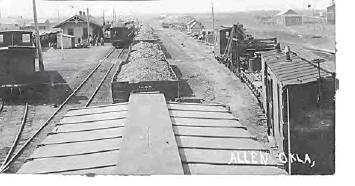
a “railroad town” like Francis had a few years earlier. The three-stall frame roundhouse was located north of the main line and across the street to the east of the Sun Oil Company Refi nery. The roundhouse was built in 1917 and was closed in 1928 when repair facilities were moved to Denison and Muskogee. Also located in Allen was a large coaling tower and water tank which were necessary for the steam engines of that period.
During the first four decades of this century there was a great amount of oil field activity in the Allen area and all the freights hauled many tank cars to and from the refinery. Coal was another item that filled many cars on every train coming into the county during this time.
When World War I occurred, many local railroad men rushed to the colors. Because of their specialized skills men, from the K. O. & G., Katy, Santa Fe and Frisco were put into a group which became the 66th Engineer Regiment. They ate their last meal in the county at the Harvey House in Francis and then went north to Laurel, Maryland for training. From there they sailed to St. Nazaire, France. As a part of the American Expeditionary Force they performed the vital function of moving supplies over European railways for American troops.
Shortly before going to France the unit changed names and became the 21st Transportation Regiment. Once overseas, these men had to learn to run French and Belgium locomotives, different signals and cars, and almost start over in railroading. Later in 1918, American built engines arrived and were put to use, much to the pleasure of these men. After having a very successful tour of duty, the 21st Transportation Regiment returned to the United States in 1919 and many of the men returned to their former railroad duties.
As to passenger operations on the K. O. & G., these remained virtually unchanged from 1909 until after the end of World War II in 1945. Each day two trains would go north and two trains would go south. Another train would come from Muskogee to Allen, spend the night and return the following day. White passengers on this train stayed in the local hotels and ate in the cafes in town. However, during the early years Allen did not have any negroes in the town nor any facilities for them. Most of them spending the night in Allen slept on the train and many railroad men made some extra money bringing them food and other items.
In 1946, due to a sharp decline in passengers, several trains were removed and all that remained was one daily north bound and one south bound each day. By the end of the year in 1946, these trains No’s. 9 and 10 were removed from service. Then for several years the K. O. & G. operated a self-propelled rail motor car from Muskogee to Allen. The rapid development of the gasoline engine and mechanical transmission designed for motor trucks was responsible for the development of the rail motor car for local and branch line service. The motor local which operated in and out of Allen was a sixty foot long car which contained the crew, engines, baggage and space for twelve passengers. Finally, by 1950, even this meager service was not self-supporting and was removed.
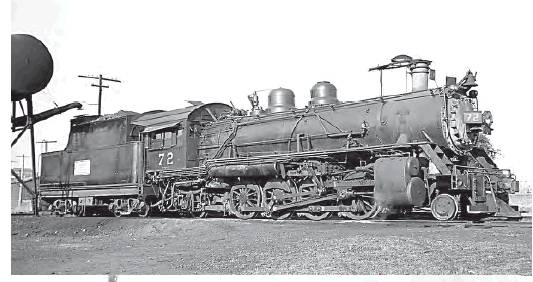
Back in the days when the passenger trains really rolled through this county on the K. O. & G., they were headed up by “Atlantic” engine. Each train usually contained one baggage car, mail car and two passenger coaches. Freight locomotives naturally were more varied. For locals and switching a Consolidation type was used. Medium size freight trains were pulled by “Mikado” engines. The long-haul freights of up to seventy cars were headed up by “Mallet” engines. These were the largest steam locomotives ever in “operation and the K. O. & G. had fi ve of them (numbers 300-304). Originally, beside the engineer in the cab, it took two firemen to feed the fire-box of these huge Mallets. Later mechanical auger-type stokers were installed and this replaced one fi reman and somewhat eliminated the rigorous duties of the remaining fi remen.
In 1947, the K. O. & G. converted their motive power to all diesel locomotives. A year later, after the crews had enough experience with the new engines, they started hauling freights of up to 167 cars. As with any machine, there are advantages and disadvantages. The well-liked steam engine was alive and you could “hear” how it was running. On the minus side was the fact that its load was limited. Diesels on the other hand are clean, can pull more, but are loud and the engineer could not tell when a unit went out.
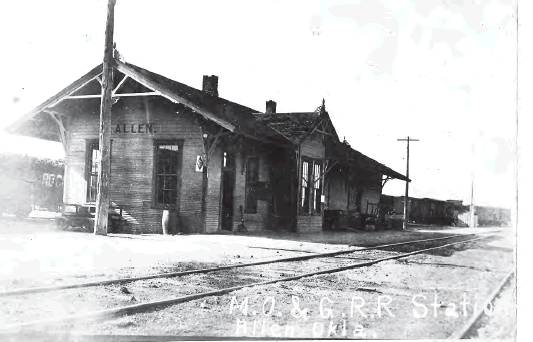
In 1963 the depot in Allen was removed as it was not needed. A new maintenance structure was erected, to serve the railroad, on the same site. This new metal building was smaller but far more functional than the old one had been.
In 1967 the Texas and Pacific Railroad purchased both the K. O. & G and the O.C.-A-A. The Texas and Pacific is a part of the Mo-Pac (Missouri Pacifi c System) along with the Chicago & Eastern Illinois Railroad. The Texas and Pacifi c sold the O.C.-A-A to the Santa Fe Railroad at that time. However, they were very interested in the former K. O. & G. track as it put them 200 miles closer to Texas than their old line did.
In 1967, the red “buzz-saw herald” of the Missouri Pacific had become a familiar sight in Allen. The railroad spent a fortune in laying 119 pound “ribbon rail” through the county and in improving communications. Seven trains a day pass through Allen and all of them are dispatched from Denison.
In the 1990 the tracks through Allen were abandoned and removed.
Our thanks to Sandra Roberts of The Diamond Shop, Ada, for sharing information from the Pontotoc County Historical Society. Info was also taken from the Allen Historical Society.